10 June 2026 Elena Toniolo
Journal of Experiences
When a global brand chooses to observe how people experience digital, research becomes a space for shared understanding. This is what happened in the project we created for Armani.
“People express at any moment in time what they wish, live, fear.
Listening is enough.” – The Sixth W manifesto
This seems like a simple statement. In reality, especially when it comes to global digital experiences, truly listening is a complex task: it requires method, attention, the ability to observe, and the willingness to suspend one’s assumptions.
In the project we conducted for Armani, this listening took the form of international research on the armani.com experience, designed to understand how people from different countries experience the site, what barriers they encounter, what expectations they bring with them, and what elements support or weaken the quality of interaction.
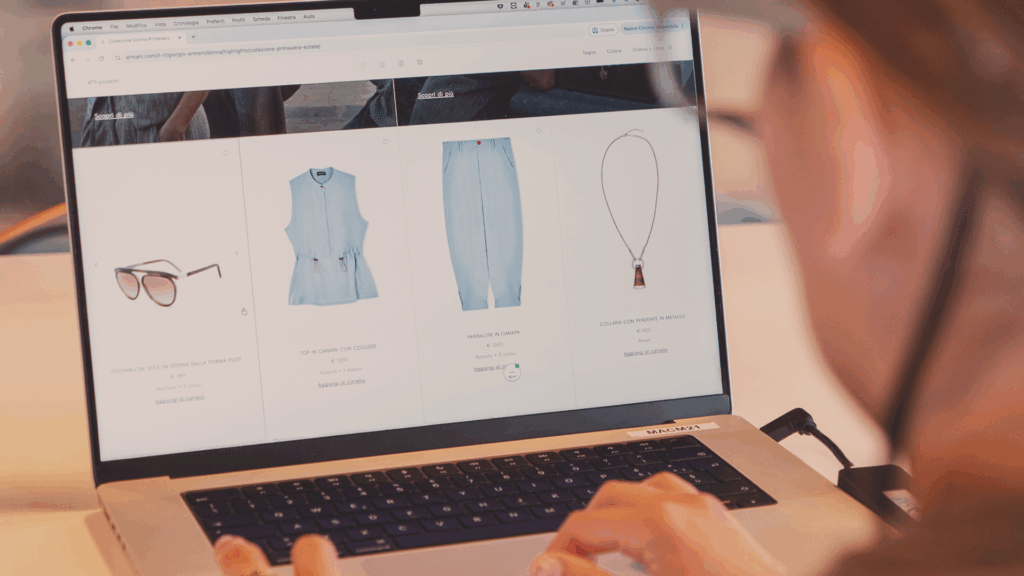
A global experience is never experienced the same way by everyone
The same digital environment can be experienced differently depending on cultural context, browsing habits, brand relationship, familiarity with e-commerce, and the way one interprets signals, content, and visual hierarchies.
For this reason, the project involved people from different countries, including Italy, the United States, Japan, the United Kingdom, and Germany. The goal was not to gather opinions from different markets, but rather to gain a deeper understanding of how an experience is perceived and experienced, whether it changes or remains constant.
Research begins before the experience test
Every listening project begins long before the meeting with participants.
It begins when we ask ourselves:
- what we really want to understand;
- what behaviors to observe;
- which areas of the experience to focus on;
- what decisions this work will help to make.
In the work we did for Armani, the design phase was crucial. We built a test plan capable of directing the research: defining the tasks, identifying the areas of the site to explore, pinpointing potential friction points, clarifying which signals to observe in relation to usability, content comprehension, visual feedback, and brand perception.
Identifying the right people is also part of the method. Defining the target means establishing who can truly deliver an experience relevant to the context being observed: age, digital familiarity, propensity to purchase online, socio-demographic characteristics, geographical origin.
When this step is carefully managed, the research becomes more reliable, and the insights that emerge become more useful in guiding subsequent decisions.
Observing what people do, say, and feel
In our work, people’s words are just a starting point. To truly understand an experience, it’s often necessary to also observe what happens during the interaction; for this reason, in the Armani project, we combined qualitative research with other analysis tools.
First, during the tests, each participant was accompanied by a facilitator in a context designed to put them at ease. This is because only when a person feels free to express themselves is it possible to observe the experience in an authentic and natural way.
Through dialogue, think-aloud, and direct observation, we then gathered valuable insights into what people noticed, were looking for, expected, or found unclear; we saw where the interaction flowed well and where, instead, doubts or difficulties arose.
Alongside this listening phase, we also employed our scientific instruments, such as eye tracking, to understand which elements attracted attention and which went unnoticed.
This tool isn’t meant to replace people’s voices, but rather to complement them. It helps us connect what a person says with what they do and with the signals that emerge as they live the experience.
It’s in this intersection of story, behavior, and reaction that research can provide a deeper and more useful interpretation, precisely because truly understanding an experience means listening to people in everything they express, not just with their words.
When the customer observes, the quality of understanding changes.
One of the most important aspects of this project was the direct involvement of Armani stakeholders in the moments of observation. Whenever possible, we always try to create a space where those who design, decide, and manage an experience can also see it happen.
Observing someone orienting themselves, hesitating, interpreting, searching for a foothold, struggling, or finding fluidity is very different from receiving an insight already summarized in a document: understanding becomes more concrete when it also comes through direct observation.
In these moments, something valuable is created: a form of alignment that arises not from an opinion, but from a shared experience of observation, and it is often there that organizations truly begin to shift their perspective.
From understanding critical issues to prioritizing choices
Research is valuable when it generates movement, when it helps make decisions. Therefore, the reporting process was designed as a tool to guide Armani in identifying priorities.
The project’s output therefore included:
- categorizing the main barriers to experience;
- interpreting them in terms of relevance and impact;
- eye movement heatmaps;
- visual and video materials useful for understanding the context of the critical issues;
- hypothesized conservative solutions;
- a prioritization matrix to distinguish more immediate improvements, strategic opportunities, and areas for further exploration.
This part is crucial, because it is the point at which research ceases to be purely knowledge-generating and becomes a design lever.
What remains, in the end, of a project like this
At the end of a project of this magnitude, we are left with the confirmation of something we deeply believe in: the best experiences aren’t built at a distance from people, but rather with them, observing them, listening to them, engaging them, accepting that they, very often, show us what we hadn’t seen. This is precisely how the greatest value is generated: in the possibility of helping a global brand maintain its identity, without losing touch with the real people who encounter, interpret, and live that identity.
The project created for Armani was important for its international scope, for the quality of the discussion, and for the opportunity to intertwine qualitative research, behavioral observation, and neuroscience. It was important because it highlighted, once again, the value of our approach.
Connecting those who design with those who live the experience, creating contexts in which listening becomes concrete, and transforming what emerges into a solid foundation for making better decisions—for us, that means working with.