2 July 2026 Valentina Cenedese
Journal of Experiences
An international research project to design a digital experience consistent with the brand’s regenerative vision, starting by listening to people
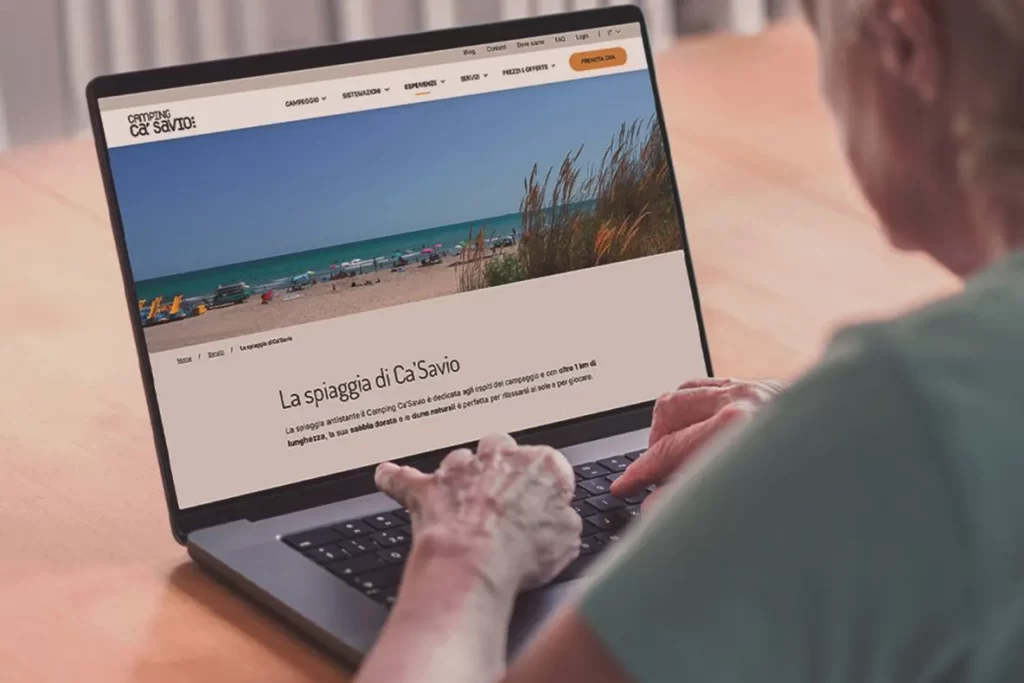
In recent years, Camping Ca’Savio has embarked on a profound transformation. Not so much to shed its skin, but to better focus on what it aspires to be today: a true tourism ecosystem geared towards regeneration.
In such a context of significant change, digital technology plays a central role. To support this transition, Camping Ca’Savio involved us in a complex project, developed over time through various research and listening activities: from tree test to mystery shopping to the BARTT (Brand Association Reaction Time Test) before and after exploring the Experience Lab section.
These different activities, but united by the same goal: to better understand people’s expectations, needs, perceptions, and mental models.
The experience test on the prototype of the new website was the culmination of this journey.
Observing the right audience to understand the experience
For this phase of the project, choosing the right people to involve wasn’t just an operational detail, but an essential part of the research.
Camping Ca’ Savio’s new digital ecosystem is specifically aimed at a German audience; therefore, listening to these people was crucial. When designing a digital experience, it’s not enough to gather general opinions; it’s important to closely observe the people for whom the experience is intended. Each audience brings with it specific habits, expectations, sensitivities, and evaluation criteria, and these elements also vary based on their cultural background.
In the case of Camping Ca’ Savio, involving German speakers allowed us to test the prototype with those who truly represent a strategic segment of the brand’s audience.
Therefore, we selected people who fit the typical profile of campsite guests: parents or grandparents of children up to 12 years old, regular campsite visitors, with diverse experiences with different types of accommodation, and aged between 35 and 65.
The value of experience test in brand storytelling
Experience test means going beyond a purely functional evaluation of the interface. Aspects such as comprehensibility, orientation, clarity of paths, and access to information played an important role, but the deeper value of the activity lay elsewhere: understanding whether the new site was truly capable of conveying the Camping Ca’ Savio vision, even on a perceptual and relational level.
The question, therefore, was not just “does it work?” but also: does it truly convey what this place aspires to be? Does it convey that sense of balance, reconnection, attention to nature, and the quality of time spent? Or does something get lost along the way?
Discussions with the people involved provided valuable feedback not only on what was clear, but also on how certain messages, linguistic choices, and elements of the digital experience were interpreted through specific cultural sensibilities.
And this is precisely where in-person research, in the target country, revealed its full value. Because listening isn’t just about gathering answers, it’s also about picking up hesitations, implicit expectations, spontaneous reactions, words used naturally and words that are left out.
Why cultural context changes the way we interpret an experience
People don’t read a website neutrally; they do so based on their own habits, references, and their own understanding of a vacation. Therefore, observing the German audience was crucial.
During the tests, we observed how certain aspects of the experience were particularly relevant to this target audience: the need for clarity, the search for coherence between promise and offer, attention to the concrete details of organizing the stay, but also sensitivity to issues such as nature, well-being, and the quality of time spent.
Collaboration with the German interpreter also enriched the experience, playing an important role both linguistically and in building rapport with the participants.
The harmony and trust built during the sessions allowed us to maintain a lively dialogue, explore the most interesting points, and provide participants with a genuine space for expression.
A further step towards a coherent experience
The experience test conducted in Germany is therefore an important step in a broader research project, developed together with Camping Ca’ Savio to support its evolution.
A project in which digital is conceived as a space capable of coherently expressing the brand’s vision and guiding people towards a more conscious relationship with vacation, the local area, and time.
For us, this activity also represented a confirmation: when the right space is created for authentic listening, people always provide much more than an opinion: they provide context, meaning, expectations, and emotions. And this is where the best experiences take shape.