6 July 2026 Giuditta Armiraglio
Journal of Experiences
A day dedicated to discussing the opportunities and limitations of brand visibility in the AI ecosystem, always putting people at the center
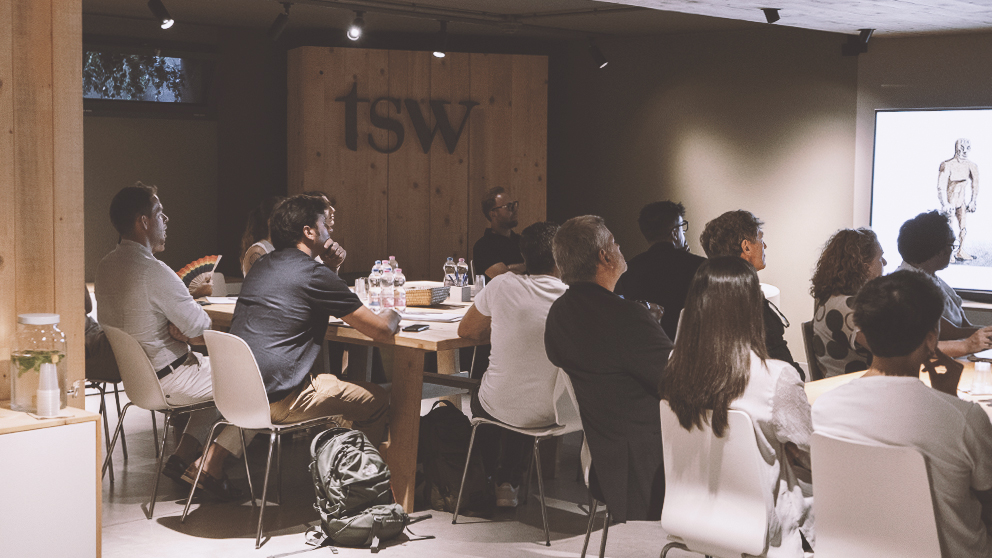
On June 30, 2026, we welcomed some of our clients to the TSW headquarters, specifically to our lab, which for the day transformed into a space for in-depth discussion and discussion among professionals from various sectors, each with a diverse and stimulating perspective.
The day’s central theme was both timely and sensitive: the new interpretative challenges for brands in the AI ecosystem. It was an opportunity to observe what is changing and discuss together how to interpret a phenomenon that is increasingly influencing the way people search for information, compare options, and make decisions.
This event also represented an important step for us: the second chapter of a journey that began a year ago, when we organized a first event on the same topics. Back then, our method was still in the research and development phase. Today, however, Amplif-AI is a consolidated method, already applied effectively for clients across diverse sectors, from energy to consumer goods.
The day’s underlying theme: complexity
The key concept of the day was complexity. Therefore, first and foremost, we wanted to share an invitation not to simplify. It’s important not to think that the relationship between brands and generative AI is linear, predictable, or immediately understandable. Appearances, in this context, can often be deceiving.
We opened the day with a question to the guests: who has recently made a decision using AI? The responses revealed very concrete behaviors: using LLMs to get advice, compare products, delve deeper into features, and quickly evaluate other users’ feedback. But along with the usefulness, doubts and cautions also emerged. We immediately got to the heart of the matter by talking about trust in LLMs, and this first conversation clearly demonstrated how much the topic has become present in everyday life, and also how reductive it is to approach it superficially.
AI raises profound questions
Edoardo Ferrini, Head of SEO & GEO at TSW, chose to begin the day with Raphael's The School of Athens. This symbolic image illustrates the growing debate surrounding artificial intelligence that is not only technical, but also cultural and philosophical. The Internet has been a huge revolution, but AI is touching even deeper chords, sparking a debate on creativity, consciousness, and the meaning of human thought.
Many scholars and specialists, both scientists and humanists, are questioning the essence of the human being in relation to something that humanity itself has generated: something artificial, inorganic, yet capable of producing powerful real-world effects. Unexpected things happen within LLMs, difficult to predict even for those who develop and manage them.
From this perspective, we compared brand visibility to the paradox of Schrödinger's cat: in generative systems, a brand's presence is not fixed. It can appear, disappear, change tone and relevance depending on the context and the wording of the question.
From SEO to GEO: from determinism to probabilism
Speaking about the complexity of LLMs, Luca Martorano, UX Research Team Leader at TSW, recalled the butterfly effect cited in Jurassic Park: in a complex system, a minimal change generates significant consequences. This was the starting point for getting to the point that most interests brands: what changes in the way they are found and represented when moving from SEO to GEO?
In traditional SEO, we're accustomed to a relatively deterministic model: a query corresponds to a fairly stable ranking. In LLMs, however, probabilism comes into play. The same question can produce different answers, and brand visibility no longer coincides with a position to be occupied, but with the probability of being included in a response.
This also requires us to be cautious about the false myths of GEO: many interpretations that are still too close to the SEO mindset risk missing the true nature of these systems.
Amplif-AI: starting with real people
The second part of the day was dedicated to an in-depth look at Amplif-AI, the method developed by TSW to analyze brand visibility and representation in LLM programs.
Its key feature is that it starts with people's real questions, not artificially generated prompts or traditional keywords. This is its most distinctive feature compared to other tools currently on the market.
The method is divided into three phases:
- Research on the new human search experience. Returning to the theme of humanism, the focus is not on the machine, but on the person: a researcher directly observes people as they interact with LLMs, capturing the authentic intentions that guide conversations. These intentions are different from SEO ones: they are not, for example, purely navigational or transactional, but conversational, comparative, oriented towards reassurance or the resolution of a specific problem.
- Amplification and measurement. Real intentions are transformed into questions, which are then statistically amplified and systematically subjected to the main linguistic models. Each question is repeated multiple times, across multiple models. A response is not observed, but statistical behavior is observed.
- Human analysis and strategic direction. The results are processed by an internal team—researchers, analysts, SEO-GEO specialists, and strategists—and returned to the client in the form of a customized dashboard and strategy document. More than just metrics: an intelligence tool that identifies problems, limitations, areas for improvement, and concrete business levers.
During the collaborative session, through a practical exercise, participants were able to observe the variety and complexity of questions that real people ask LLM students on the same topic. The variability of wording—and its direct impact on the variability of responses—highlighted the reductive nature of relying on a single prompt to assess how a brand is represented. A case study of the Amplif-AI method was also presented, which generated considerable interest and many questions from those in attendance.
An opportunity to care for our customers
For us at TSW, caring for our customers also means engaging them with the most current challenges, with depth and critical attention. For us at TSW, talking about AI doesn't mean chasing a technological breakthrough; it means helping companies better understand what's changing, always starting with real people and their experiences.
And this is precisely where we will continue: from real questions, from a complexity that cannot be simplified, from methods capable of transforming data into useful knowledge for making better decisions.
We thank our guests: Alì Supermarkets, buddy UniCredit, Cetif – Research Center of the Catholic University of Milan, Doctors with Africa CUAMM, Exclama, Fidelity, Forel, Foscarin Group, Lazzaris, Luxardo, Nims – Lavazza Group, Sisal, Specialingranaggi, Tecnica Group, Ulss2 Marca Trevigiana, and Wide Group.