10 April 2026 Laura Bottaro
Journal of Experiences
Transforming a party game into a visual language experiment: 5 people, 20 words, a timer, and many interpretations. A timed drawing game as a co-creation tool to make shared meanings, ambiguities, and metaphors visible.
There are words we use every day that seem obvious: listening, strategy, co-creation, accessibility, measurement. We say them in meetings, write them on a slide, put them in a website menu. But when we try to translate them into a symbol, like an icon, a drawing, or a visual metaphor, something interesting happens: the meaning stops being “implicit” and becomes an explicit choice. You have to decide what to put in and what to leave out. This sparked curiosity: using a quick game to bring out the “first meaning” a word triggers in people, and observe what happens when that meaning needs to take shape.
Picto Rush: draw in 20 seconds (and remember what you draw)
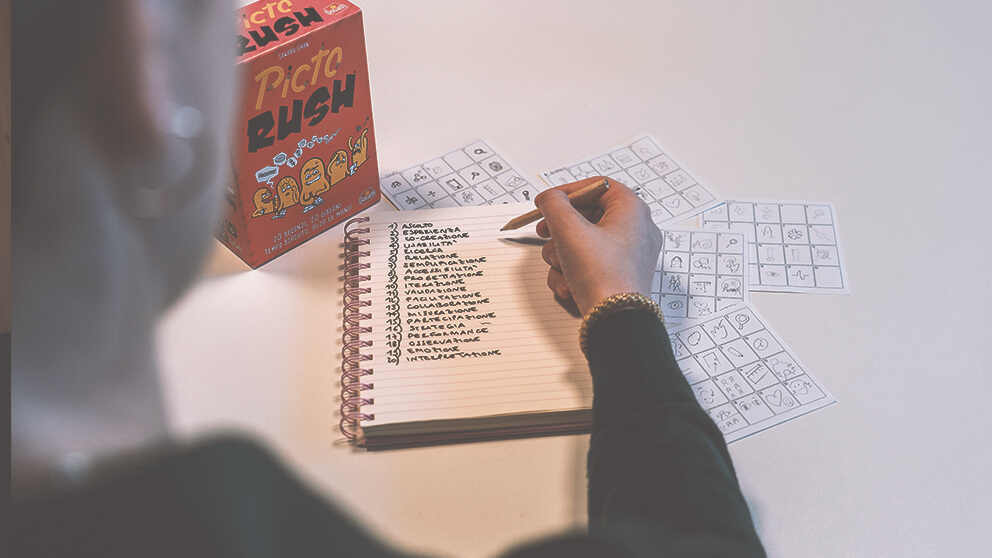
Picto Rush is a lightning-fast drawing party game that combines creativity and memory. Each turn, players draw a card with a sequence of words/objects, and when the timer starts, players must scribble a drawing for each item as quickly as possible, ideally completing 20 drawings in 20 seconds. Once the timer runs out, the memory component comes into play, as players must reconstruct and declare (i.e., remember) what those mini-drawings represented, while the other players check/verify based on the card and are awarded points based on how many correct associations they make. So, it’s not the quality of the drawing that matters, but rather who can produce enough distinctive symbols to be remembered immediately.
The idea: using speed to bring out metaphors
Taking inspiration from Picto Rush, the format can be transformed into a small experiment in design and observation. The starting hypothesis is this: the most immediate synthesis tends to produce more universal symbols, because:
- it was born before rationalizations;
- search for shared visual shortcuts;
- naturally reduces detail and complexity.
The test: 5 people, 20 words, a timer
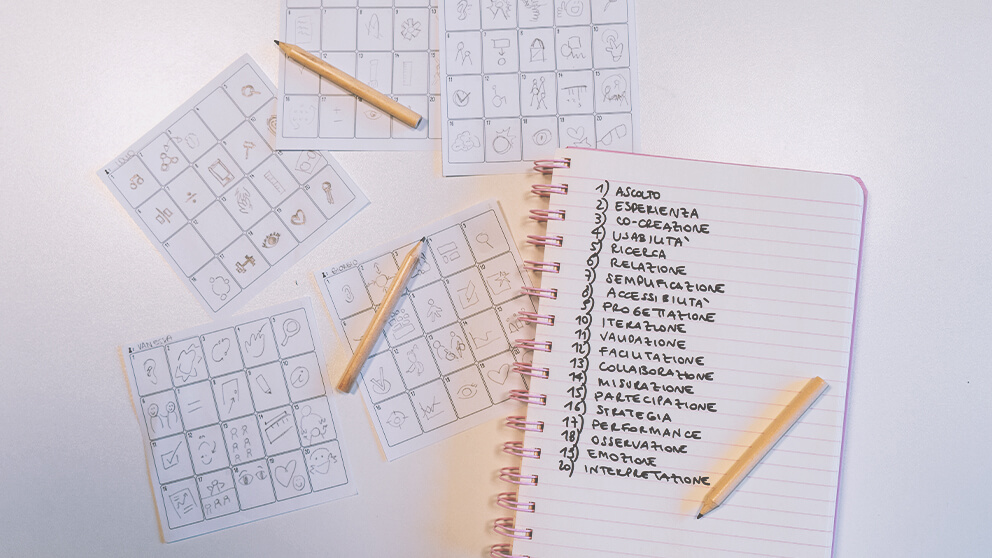
To test the idea, we organized a simple test with five people and a timer, starting with a list of words that attempt to summarize TSW and its way of working. The goal isn’t to “draw well,” but to bring out spontaneous and recurring visual metaphors: starting material from which to hypothesize an initial set of icons consistent with the brand, which can then be used as the basis for more systematic design work.
In this case, the 20 words chosen are: Listening, Experience, Co-creation, Usability, Research, Relationship, Simplification, Accessibility, Design, Interaction, Validation, Facilitation, Collaboration, Measurement, Participation, Strategy, Performance, Observation, Emotion, Interpretation.
The same approach, however, can be replicated with any brand or project: simply replace the list with concepts that represent its values, activities, and promises, and use quick drawing as a tool to understand which symbols are truly immediate and shared.
The limits of instinctive synthesis
The idea is to use a “speed” context to bring out spontaneous visual metaphors and then gradually transform them into a coherent set of icons. It often works: what comes to mind first tends to be the most shared, and therefore most recognizable. However, immediacy alone isn’t enough: an “instinctive” symbol can be too generic, overlap with other concepts, or be interpreted differently depending on cultural background. Transforming intuition into a useful system therefore requires a minimum of method: observe recurring patterns and potential collisions, choose carefully, and quickly verify understanding.
What emerges: three recurring phenomena
Without requiring statistically rigorous measurements (with a small group it would not make sense), three patterns tend to appear.
1) When the team converges: the visual language is already there
For some words, the drawings tend to resemble each other, as if there were a pre-existing, ready-to-use visual convention. In these cases, the work isn’t about inventing: it’s about choosing and standardizing. It’s also a useful reminder: sometimes co-creation isn’t about finding original ideas, but rather about highlighting which symbols are already shared.
In the test, for example, in Listening, 3 people drew an ear; in Research, 5 people drew a magnifying glass; in Design, 3 people drew a pencil; in Validation, 4 people drew a check; in Collaboration, 3 people drew several people together; in Measurement, 4 people drew a tape measure; in Observation, 5 people drew an eye; and in Emotion, 4 people drew a heart.
When this happens, the question isn’t “what icon do we invent?”, but “what variant do we choose and how do we make it consistent with the rest of the set?”
2) When the team diverges: the word is broad, or it is not really shared
For other words, however, very different drawings are produced. This doesn’t mean the concept isn’t understood: it means it’s large enough to accommodate different interpretations. Herein lies one of the most interesting values of the experiment: the drawing makes ambiguity visible. A word may seem clear until people are asked to capture it in a symbol.
In the test, Usability was a prime example: two people didn’t draw anything, and the other three people produced three different ideas; the Interaction tests also produced completely different drawings, and the same thing happened with Facilitation and Experience.
In these cases, the divergence isn’t a problem to be solved immediately: it’s a warning sign. It could indicate that the word is too broad to be rendered as an icon with a single symbol, that there’s no shared definition within the team. It’s also the point where the test stops being just a graphic exercise and becomes useful at the linguistic level: before choosing an icon, it’s best to clarify what you really want to convey with that term (and in what context), otherwise you risk producing decorative symbols, or worse, inconsistent with each other.
3) Collisions: different symbols, concepts that are too similar
Then there is a third case, especially delicate when designing a system of icons: different words that “pull” towards the same symbol.
In the test it was clearly seen: the person symbol was designed for Relationship, Collaboration and Participation.
Here, design work can’t simply collect: it must create differences. These are typical examples of similar concepts that risk becoming indistinguishable icons. Not because the team “wasn’t good,” but because a system must function as a system, and each sign must have its own space.
From co-creation to design: how to transform drawings into a system
After the game phase, the drawings can be treated as research material: not as final solutions, but as data.
A simple process can follow four steps:
1) Group by metaphor
For each word, similar drawings are put together and the family is given a name (e.g. “waves”, “dialogue”, “tool”, “path”…).
2) Choose according to criteria (not taste):
- immediate recognisability;
- distinctiveness from other icons;
- readability at small sizes;
- robustness out of context.
3) Define a mini-visual grammar
Grid, line weight, angles, level of detail: crucial choices to make a set coherent.
4) Do a micro-test without labels
Show the icons without text to a few people and ask, “What does it tell you?” If the responses are slow or divergent, it’s not a failure: it’s useful information to correct the metaphor or increase its distinctiveness.
The lesson (which goes beyond the icons)
The result isn’t just a set of symbols. The point is that co-creating also means co-defining. Visual language accelerates this process because it forces us to make choices explicit: it requires identifying a metaphor and clarifying what a word really means.
The exercise also highlights an often overlooked aspect: many of the words we use in everyday work work precisely because they remain, in part, vague. This vagueness facilitates conversation, but it becomes a limitation when those concepts need to take concrete form—in an icon, an interface, or a process.
In these cases, the vagueness must be clarified. And doing so together is already part of the design process.